# 🎬 Huobao Drama - AI Short Drama Production Platform
**Full-stack AI Short Drama Automation Platform Based on Go + Vue3**
[](https://golang.org)
[](https://vuejs.org)
[](https://creativecommons.org/licenses/by-nc-sa/4.0/)
[Features](#features) • [Quick Start](#quick-start) • [Deployment](#deployment)
[简体中文](README-CN.md) | [English](README.md) | [日本語](README-JA.md)
---
## 📖 About
Huobao Drama is an AI-powered short drama production platform that automates the entire workflow from script generation, character design, storyboarding to video composition.
### 🎯 Core Features
- **🤖 AI-Driven**: Parse scripts using large language models to extract characters, scenes, and storyboards
- **🎨 Intelligent Creation**: AI-generated character portraits and scene backgrounds
- **📹 Video Generation**: Automatic storyboard video generation using text-to-video and image-to-video models
- **🔄 Complete Workflow**: End-to-end production workflow from idea to final video
### 🛠️ Technical Architecture
Based on **DDD (Domain-Driven Design)** with clear layering:
```
├── API Layer (Gin HTTP)
├── Application Service Layer (Business Logic)
├── Domain Layer (Domain Models)
└── Infrastructure Layer (Database, External Services)
```
### 🎥 Demo Videos
Experience AI short drama generation:
**Sample Work 1**
**Sample Work 2**
[Watch Video 1](https://ffile.chatfire.site/cf/public/20260114094337396.mp4) | [Watch Video 2](https://ffile.chatfire.site/cf/public/fcede75e8aeafe22031dbf78f86285b8.mp4)
---
## ✨ Features
### 🎭 Character Management
- ✅ AI-generated character portraits
- ✅ Batch character generation
- ✅ Character image upload and management
### 🎬 Storyboard Production
- ✅ Automatic storyboard script generation
- ✅ Scene descriptions and shot design
- ✅ Storyboard image generation (text-to-image)
- ✅ Frame type selection (first frame/key frame/last frame/panel)
### 🎥 Video Generation
- ✅ Automatic image-to-video generation
- ✅ Video composition and editing
- ✅ Transition effects
### 📦 Asset Management
- ✅ Unified asset library management
- ✅ Local storage support
- ✅ Asset import/export
- ✅ Task progress tracking
---
## 🚀 Quick Start
### 📋 Prerequisites
| Software | Version | Description |
| ----------- | ------- | ------------------------------- |
| **Go** | 1.23+ | Backend runtime |
| **Node.js** | 18+ | Frontend build environment |
| **npm** | 9+ | Package manager |
| **FFmpeg** | 4.0+ | Video processing (**Required**) |
| **SQLite** | 3.x | Database (built-in) |
#### Installing FFmpeg
**macOS:**
```bash
brew install ffmpeg
```
**Ubuntu/Debian:**
```bash
sudo apt update
sudo apt install ffmpeg
```
**Windows:**
Download from [FFmpeg Official Site](https://ffmpeg.org/download.html) and configure environment variables
Verify installation:
```bash
ffmpeg -version
```
### ⚙️ Configuration
Copy and edit the configuration file:
```bash
cp configs/config.example.yaml configs/config.yaml
vim configs/config.yaml
```
Configuration file format (`configs/config.yaml`):
```yaml
app:
name: "Huobao Drama API"
version: "1.0.0"
debug: true # Set to true for development, false for production
server:
port: 5678
host: "0.0.0.0"
cors_origins:
- "http://localhost:3012"
read_timeout: 600
write_timeout: 600
database:
type: "sqlite"
path: "./data/drama_generator.db"
max_idle: 10
max_open: 100
storage:
type: "local"
local_path: "./data/storage"
base_url: "http://localhost:5678/static"
ai:
default_text_provider: "openai"
default_image_provider: "openai"
default_video_provider: "doubao"
```
**Key Configuration Items:**
- `app.debug`: Debug mode switch (recommended true for development)
- `server.port`: Service port
- `server.cors_origins`: Allowed CORS origins for frontend
- `database.path`: SQLite database file path
- `storage.local_path`: Local file storage path
- `storage.base_url`: Static resource access URL
- `ai.default_*_provider`: AI service provider configuration (API keys configured in Web UI)
### 📥 Installation
```bash
# Clone the project
git clone https://github.com/chatfire-AI/huobao-drama.git
cd huobao-drama
# Install Go dependencies
go mod download
# Install frontend dependencies
cd web
npm install
cd ..
```
### 🎯 Starting the Project
#### Method 1: Development Mode (Recommended)
**Frontend and backend separation with hot reload**
```bash
# Terminal 1: Start backend service
go run main.go
# Terminal 2: Start frontend dev server
cd web
npm run dev
```
- Frontend: `http://localhost:3012`
- Backend API: `http://localhost:5678/api/v1`
- Frontend automatically proxies API requests to backend
#### Method 2: Single Service Mode
**Backend serves both API and frontend static files**
```bash
# 1. Build frontend
cd web
npm run build
cd ..
# 2. Start service
go run main.go
```
Access: `http://localhost:5678`
### 🗄️ Database Initialization
Database tables are automatically created on first startup (using GORM AutoMigrate), no manual migration needed.
---
## 📦 Deployment
### 🐳 Docker Deployment (Recommended)
#### Method 1: Docker Compose (Recommended)
#### 🚀 China Network Acceleration (Optional)
If you are in China, pulling Docker images and installing dependencies may be slow. You can speed up the build process by configuring mirror sources.
**Step 1: Create environment variable file**
```bash
cp .env.example .env
```
**Step 2: Edit `.env` file and uncomment the mirror sources you need**
```bash
# Enable Docker Hub mirror (recommended)
DOCKER_REGISTRY=docker.1ms.run/
# Enable npm mirror
NPM_REGISTRY=https://registry.npmmirror.com/
# Enable Go proxy
GO_PROXY=https://goproxy.cn,direct
# Enable Alpine mirror
ALPINE_MIRROR=mirrors.aliyun.com
```
**Step 3: Build with docker compose (required)**
```bash
docker compose build
```
> **Important Note**:
>
> - ⚠️ You must use `docker compose build` to automatically load mirror source configurations from the `.env` file
> - ❌ If using `docker build` command, you need to manually pass `--build-arg` parameters
> - ✅ Always recommended to use `docker compose build` for building
**Performance Comparison**:
| Operation | Without Mirrors | With Mirrors |
| ---------------- | --------------- | ------------ |
| Pull base images | 5-30 minutes | 1-5 minutes |
| Install npm deps | May fail | Fast success |
| Download Go deps | 5-10 minutes | 30s-1 minute |
> **Note**: Users outside China should not configure mirror sources, use default settings.
```bash
# Start services
docker-compose up -d
# View logs
docker-compose logs -f
# Stop services
docker-compose down
```
#### Method 2: Docker Command
> **Note**: Linux users need to add `--add-host=host.docker.internal:host-gateway` to access host services
```bash
# Run from Docker Hub
docker run -d \
--name huobao-drama \
-p 5678:5678 \
-v $(pwd)/data:/app/data \
--restart unless-stopped \
huobao/huobao-drama:latest
# View logs
docker logs -f huobao-drama
```
**Local Build** (optional):
```bash
docker build -t huobao-drama:latest .
docker run -d --name huobao-drama -p 5678:5678 -v $(pwd)/data:/app/data huobao-drama:latest
```
**Docker Deployment Advantages:**
- ✅ Ready to use with default configuration
- ✅ Environment consistency, avoiding dependency issues
- ✅ One-click start, no need to install Go, Node.js, FFmpeg
- ✅ Easy to migrate and scale
- ✅ Automatic health checks and restarts
- ✅ Automatic file permission handling
#### 🔗 Accessing Host Services (Ollama/Local Models)
The container is configured to access host services using `http://host.docker.internal:PORT`.
**Configuration Steps:**
1. **Start service on host (listen on all interfaces)**
```bash
export OLLAMA_HOST=0.0.0.0:11434 && ollama serve
```
2. **Frontend AI Service Configuration**
- Base URL: `http://host.docker.internal:11434/v1`
- Provider: `openai`
- Model: `qwen2.5:latest`
---
### 🏭 Traditional Deployment
#### 1. Build
```bash
# 1. Build frontend
cd web
npm run build
cd ..
# 2. Compile backend
go build -o huobao-drama .
```
Generated files:
- `huobao-drama` - Backend executable
- `web/dist/` - Frontend static files (embedded in backend)
#### 2. Prepare Deployment Files
Files to upload to server:
```
huobao-drama # Backend executable
configs/config.yaml # Configuration file
data/ # Data directory (optional, auto-created on first run)
```
#### 3. Server Configuration
```bash
# Upload files to server
scp huobao-drama user@server:/opt/huobao-drama/
scp configs/config.yaml user@server:/opt/huobao-drama/configs/
# SSH to server
ssh user@server
# Modify configuration file
cd /opt/huobao-drama
vim configs/config.yaml
# Set mode to production
# Configure domain and storage path
# Create data directory and set permissions (Important!)
# Note: Replace YOUR_USER with actual user running the service (e.g., www-data, ubuntu, deploy)
sudo mkdir -p /opt/huobao-drama/data/storage
sudo chown -R YOUR_USER:YOUR_USER /opt/huobao-drama/data
sudo chmod -R 755 /opt/huobao-drama/data
# Grant execute permission
chmod +x huobao-drama
# Start service
./huobao-drama
```
#### 4. Manage Service with systemd
Create service file `/etc/systemd/system/huobao-drama.service`:
```ini
[Unit]
Description=Huobao Drama Service
After=network.target
[Service]
Type=simple
User=YOUR_USER
WorkingDirectory=/opt/huobao-drama
ExecStart=/opt/huobao-drama/huobao-drama
Restart=on-failure
RestartSec=10
# Environment variables (optional)
# Environment="GIN_MODE=release"
[Install]
WantedBy=multi-user.target
```
Start service:
```bash
sudo systemctl daemon-reload
sudo systemctl enable huobao-drama
sudo systemctl start huobao-drama
sudo systemctl status huobao-drama
```
**⚠️ Common Issue: SQLite Write Permission Error**
If you encounter `attempt to write a readonly database` error:
```bash
# 1. Check current user running the service
sudo systemctl status huobao-drama | grep "Main PID"
ps aux | grep huobao-drama
# 2. Fix permissions (replace YOUR_USER with actual username)
sudo chown -R YOUR_USER:YOUR_USER /opt/huobao-drama/data
sudo chmod -R 755 /opt/huobao-drama/data
# 3. Verify permissions
ls -la /opt/huobao-drama/data
# Should show owner as the user running the service
# 4. Restart service
sudo systemctl restart huobao-drama
```
**Reason:**
- SQLite requires write permission on both the database file **and** its directory
- Needs to create temporary files in the directory (e.g., `-wal`, `-journal`)
- **Key**: Ensure systemd `User` matches data directory owner
**Common Usernames:**
- Ubuntu/Debian: `www-data`, `ubuntu`
- CentOS/RHEL: `nginx`, `apache`
- Custom deployment: `deploy`, `app`, current logged-in user
#### 5. Nginx Reverse Proxy
```nginx
server {
listen 80;
server_name your-domain.com;
location / {
proxy_pass http://localhost:5678;
proxy_set_header Host $host;
proxy_set_header X-Real-IP $remote_addr;
proxy_set_header X-Forwarded-For $proxy_add_x_forwarded_for;
}
# Direct access to static files
location /static/ {
alias /opt/huobao-drama/data/storage/;
}
}
```
---
## 🎨 Tech Stack
### Backend
- **Language**: Go 1.23+
- **Web Framework**: Gin 1.9+
- **ORM**: GORM
- **Database**: SQLite
- **Logging**: Zap
- **Video Processing**: FFmpeg
- **AI Services**: OpenAI, Gemini, Doubao, etc.
### Frontend
- **Framework**: Vue 3.4+
- **Language**: TypeScript 5+
- **Build Tool**: Vite 5
- **UI Components**: Element Plus
- **CSS Framework**: TailwindCSS
- **State Management**: Pinia
- **Router**: Vue Router 4
### Development Tools
- **Package Management**: Go Modules, npm
- **Code Standards**: ESLint, Prettier
- **Version Control**: Git
---
## 📝 FAQ
### Q: How can Docker containers access Ollama on the host?
A: Use `http://host.docker.internal:11434/v1` as Base URL. Note two things:
1. Host Ollama needs to listen on `0.0.0.0`: `export OLLAMA_HOST=0.0.0.0:11434 && ollama serve`
2. Linux users using `docker run` need to add: `--add-host=host.docker.internal:host-gateway`
See: [DOCKER_HOST_ACCESS.md](docs/DOCKER_HOST_ACCESS.md)
### Q: FFmpeg not installed or not found?
A: Ensure FFmpeg is installed and in the PATH environment variable. Verify with `ffmpeg -version`.
### Q: Frontend cannot connect to backend API?
A: Check if backend is running and port is correct. In development mode, frontend proxy config is in `web/vite.config.ts`.
### Q: Database tables not created?
A: GORM automatically creates tables on first startup, check logs to confirm migration success.
---
## 📋 Changelog
### v1.0.2 (2026-01-16)
#### 🚀 Major Updates
- Pure Go SQLite driver (`modernc.org/sqlite`), supports `CGO_ENABLED=0` cross-platform compilation
- Optimized concurrency performance (WAL mode), resolved "database is locked" errors
- Docker cross-platform support for `host.docker.internal` to access host services
- Streamlined documentation and deployment guides
### v1.0.1 (2026-01-14)
#### 🐛 Bug Fixes / 🔧 Improvements
- Fixed video generation API response parsing issues
- Added OpenAI Sora video endpoint configuration
- Optimized error handling and logging
---
## 🤝 Contributing
Issues and Pull Requests are welcome!
1. Fork this project
2. Create a feature branch (`git checkout -b feature/AmazingFeature`)
3. Commit your changes (`git commit -m 'Add some AmazingFeature'`)
4. Push to the branch (`git push origin feature/AmazingFeature`)
5. Open a Pull Request
---
## API Configuration Site
Configure in 2 minutes: [API Aggregation Site](https://api.chatfire.site/models)
---
## 👨💻 About Us
**AI Huobao - AI Studio Startup**
- 🏠 **Location**: Nanjing, China
- 🚀 **Status**: Startup in Progress
- 📧 **Email**: [18550175439@163.com](mailto:18550175439@163.com)
- 💬 **WeChat**: dangbao1117 (Personal WeChat - No technical support)
- 🐙 **GitHub**: [https://github.com/chatfire-AI/huobao-drama](https://github.com/chatfire-AI/huobao-drama)
> _"Let AI help us do more creative things"_
## Community Group

- Submit [Issue](../../issues)
- Email project maintainers
---
**⭐ If this project helps you, please give it a Star!**
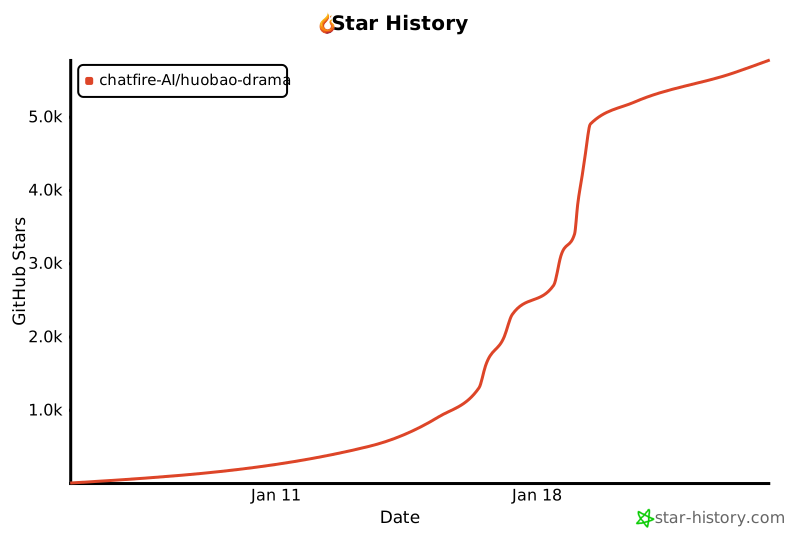
## Star History
[](https://www.star-history.com/#chatfire-AI/huobao-drama&type=date&legend=top-left)
Made with ❤️ by Huobao Team